Making time tactile
DISTRACTION artist Jess Blaustein invites you to spend time differently. We spoke to her about mindfulness, embodied time and making sense of things through material.
“I see mindfulness as a radical refusal to capitulate to the attention economy.”
Jess Blaustein (USA) is a New York-based conceptual artist who plays with soft materials to make sense of hard things. With backgrounds in architecture and the humanities, she approaches craft as a form of thinking – creating tactile works that explore how we experience time, attention and the body.
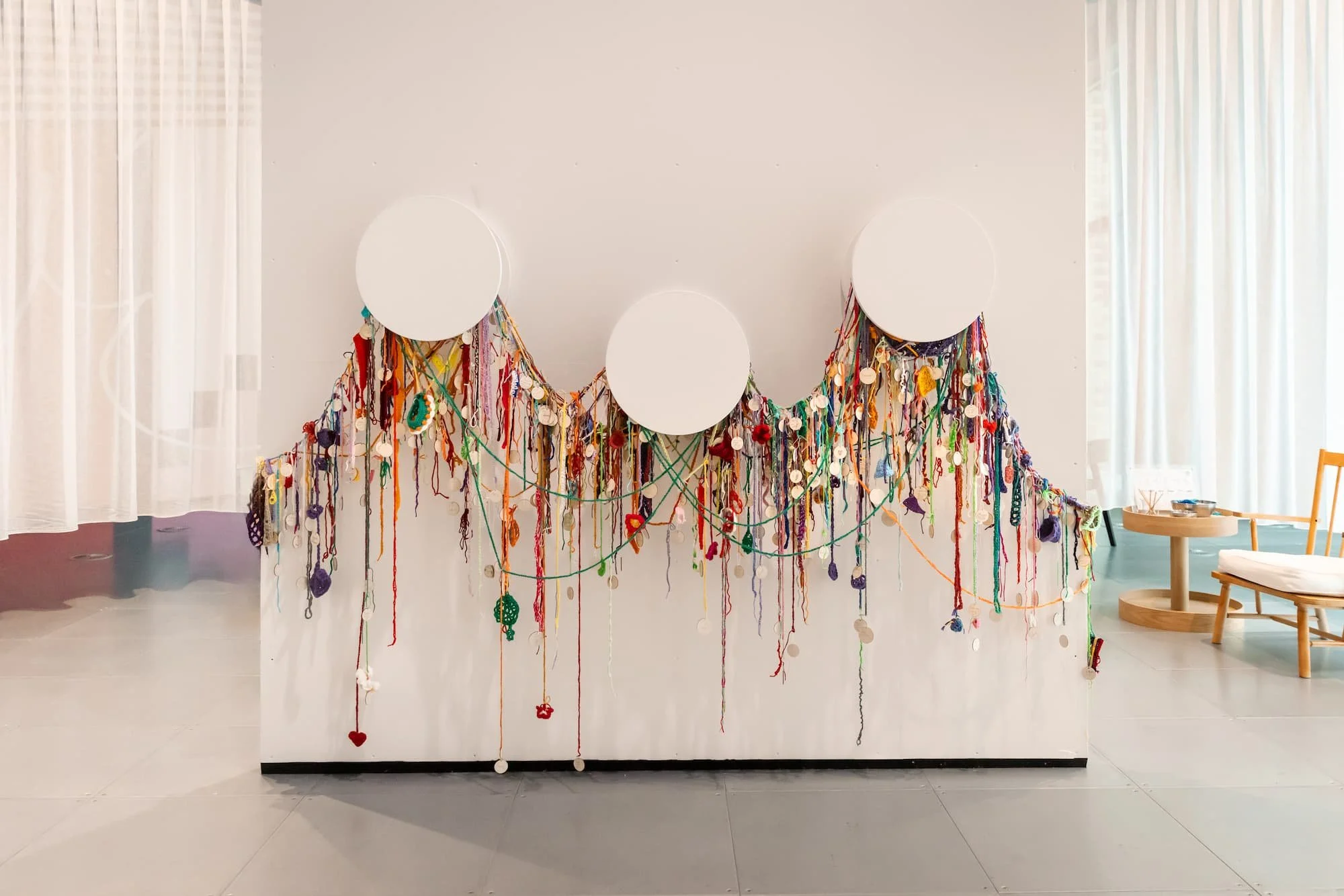
Her work, Minute Lines, transforms time into something you can hold, loop and build. Using a simple crochet chain stitch, visitors create their own “minute lines”: lengths of wool that are added to the installation. What begins as a single gesture becomes a growing, collective record of time spent together in the gallery.
Your collective artwork, Minute Lines, is very mindful. It invites visitors to slow down, use their hands and find joy in creativity. Why do you think mindfulness is so important?
For so many of us, contemporary culture makes it extremely hard to be present. Digital platforms monetize and prey onour attention which is essential to their business model. And in my country, “flooding the zone” has proven to be a terribly effective political strategy (to flood the zone is to disorient, confuse, and distract the public by overwhelming the news cycle with scandals and headlines). In these contexts, I see mindfulness as a radical refusal to capitulate to the attention economy. Importantly, Minute Lines requires using your hands. The installation invites mindfulness through the physicality of making. It explores possibilities for embodied presence through making as an antidote to disembodied distraction.
What does a minute feel like to you while you’re making? Does it ever stop matching the clock time?
I certainly hope so! Minute Lines asks us to wonder about what clock time measures, about the kind of measure that clock time is. I’m not doing away with clocks altogether in this project.
Instead, I’m trying to stage an encounter between standardized chronological time and embodied time to see what happens. It’s a collective experiment I like to think of as a form of time capture – capturing time from the clock, pushing against the busy-ness of time by being attentive to the passage of time itself. All the tags are fascinating to me. They exist in the work as signatures of a collectively authored time capture.
This work only exists because of collective participation. How do you balance control and letting go of how the work may turn out?
That’s right! Minute Lines wouldn’t exist without the amazing visitors who have collectively contributed to its making over time at the Science Gallery. I suspect the accumulated lines themselves answer the question far better than I can, as they’ve taken on a life of their own.
“Now a riot of color and energy, the installation has evolved in ways I would never have anticipated, and I love that about this project. ”
Photography credit: Darren Gill
How do I balance control and letting go? It’s a dance. There are certain conditions or boundaries laid out in advance that enable the work to grow and evolve. Controlling too much cankill the work (people don’t like to be micromanaged or overwhelmed by instructions). But without enough of a framework, things can fall flat. The challenge is to generate a responsive space that can hold, but not dictate, what happens inside it.
When the exhibition ends, what will happen to the accumulated line of time?
Stay tuned! One of the purposes of my visit is to begin imagining what form the accumulated lines will take after they are deinstalled. Originally, I had in mind to count the total number of minutes, to measure the total length of co-created lines of time, and to fabricate one giant spool to store it all. As the lines have taken on a life of their own, however, they have become in some fundamental sense immeasurable, or at least immeasurable by the standards we would normally use to measure such things. In this way, the work says so much more about collective embodied time beyond the clock or the ruler, and I’m compelled to figure out a form/format for archiving Minutes Lines that respects and communicates its poetic dimensions, while also making it possible for future display.
Crochet is often associated with domesticity and tradition. What meanings does it carry for you in this work?
Well, stitching in general carries so many wonderful associations with time – stitches themselves function in numerous ways as tactile markers of time passing (a stitch in time…). The importance of crochet specifically? I draw on many different craft traditions in my art practice, but until the Minute Lines project, crochet was actually not one of them. What led me to crochet for this work was my desire to fabricate lines in space. For an earlier version of Minute Lines, Istitched lines on canvas, like drawing on a substrate. From there, I really wanted to create lines with no substrate at all, and I found myself drawn to the crocheted chain stitch. A chain stitched line marks the beginning of more complicated structures; it is a foundation from which things grow. Crocheted, its form is also beautifully variable. Depending on type of material used and hook size, for example, the shape and length of a minute line can vary dramatically. Furthermore, even if we were to use the same size hook with the same type of material, the length of line I create in five minutes time might be significantly tighter or looser, longer or shorter, than your length of line in the same amount of time. This is because tension, attention, mood, mindset, and body – always the body! – matter enormously to the making. (I’m not sure of this is true, but I’ve also read that knitting can be accomplished by machine, while crochet stitches can only be crafted by hand…)
Repetition plays a big role in Minute Lines. What does repetition allow you to think about that a single gesture can’t?
Stitching as a practice is repetitive and generative; it builds form. There is also an important distinction to be madehere between machine-based repetition and repetition by hand. This goes back to the encounter between clock time and embodied time.
Craft can feel undervalued in the art world. Has that shaped how you talk about your art practice
Oftentimes techniques that are historically marginalized or sidelined hold secrets. They store potential and possibility. For me, craft functions as a way of making sense of things through material. I consider my art-making to be a material practice of attention, and I think about it in terms of what hands-on material manipulation can do that the digital cannot. I believe in the high value of craft as a form of thinking outside of the digital loop – not as a luddite antidote to the digital experience, but as a very deliberate practice that can open up new questions and relations.
Slow down and take part in Minute Lines by Jess Blaustein as part of our latest exhibition DISTRACTION. Join other makers to add your own line to the work during our free daytime crochet party Club Crochet in April 2026.