In Exultation of Distraction
Dr Jasmin Pfefferkorn is a Postdoctoral Research Fellow in the School of Culture and Communication at the University of Melbourne, as well as an expert advisor for DISTRACTION. For our DISTRACTION zine, Pfefferkorn wrote about her own personal account of distraction — a phenomenon worthy of exultation.
I was at a conference recently, listening to the film, media, and critical disability studies scholar Neta Alexander speaking about a Crip Theory of AI[i]. During the presentation, Alexander briefly brought up how companies are hiring blind people, based on a principle called ‘blind gain’. Blind gain, a term that builds on deaf gain[ii], reframes blindness as a benefit for society. Alexander’s point, however, was the way the concept was put in service of capital, rather than social value. Claims abound that people look at their phone once every eight minutes[iii], or glance at their email inbox up to 36 times an hour during work hours[iv]. Consequently, the blind employee is considered the ‘perfect non-distractable employee’.
Of course, there are many ways in which to be sensorially distracted that do not involve sight. What ‘blind gain’ presupposes is that, in a vision-obsessed society[i], ocular distraction is the most problematic form of distraction. A second sentiment also emerges from this concept: Distraction has the potential to be radically anti-capitalist.
This is hard to imagine when distraction has seemingly become synonymous with digital interactions, and the digital realm is primarily seen as functioning via the extractive logic of late capitalism. We think, for instance, of the algorithms that treat us like gamblers playing slots in a casino. Dosing us with small dopamine hits while taking both our money and, more importantly, our time. We speak of endlessness – the endless stream, the endless scroll. The concern that distraction is constant, rather than temporary.
But distraction is only ever fleeting. It is the thing that momentarily disrupts our concentration, our attention drawn elsewhere. According to the philosopher Henri Bergson, we experience time through shifts in intensity within the wider experience of life as a continuous flow[vi]. Distraction, it might be said, is a core characteristic of shifting intensities, and therefore a necessary way for us to experience time outside of the ‘objective time’ (Bergson again) of clocks and calendar cycles. In the hyperbolic ‘nine-to-five’ of the workday, distraction helps us feel time on our own terms.

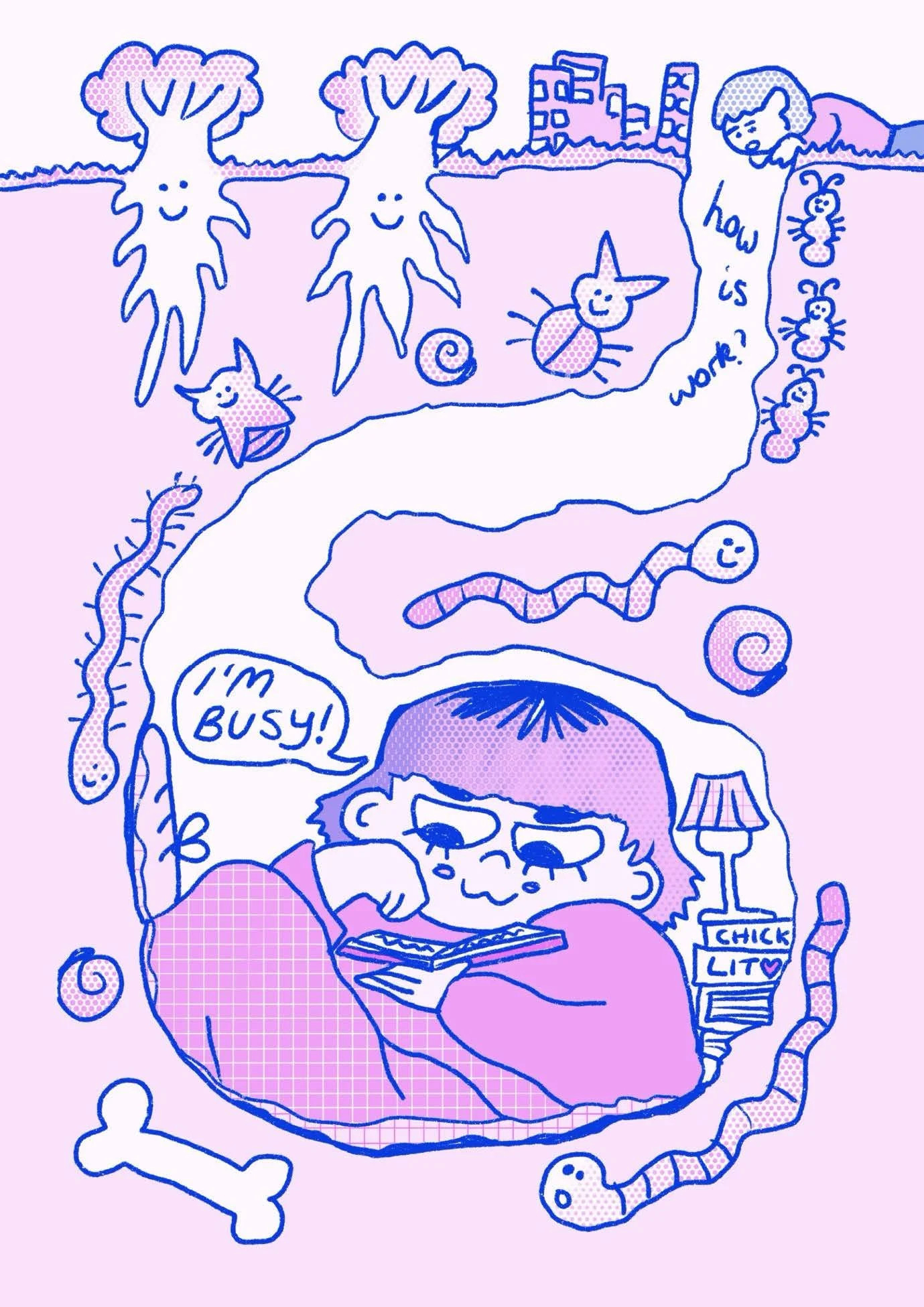
Hidey Hole by Zeth Cameron for the DISTRACTION zine
Distraction can also aide in creativity. It helps connect disparate ideas and concepts together, creating new associative thoughts [vii]. The notion of distraction as a benefit, rather than something to be avoided, has also fallen victim to the rhetorics of workplace productivity. So, while we cannot completely avoid the subsumption of distraction by capitalism, perhaps we can try to reclaim it. Perhaps we should focus on that potential – the ways in which distraction benefits us and our sense of wellbeing, our sense of living life, rather than its impact on workplace performance, or our lack of sovereignty over our attention.
“Distraction is a reminder of our relationality,
that we are a part of the world. ”
We are not machines, but organisms. We are oriented towards our environments, sensorially attuned to what is happening around us, not optimised for single-minded focus on a prescribed task. Distraction is a reminder of our relationality, that we are a part of the world.
So let us exult in distraction. In the daydream of it all. The meandering of mind. In the creative spark of the sensorially entangled!
References
[i] Alexander, N. 2025. Keynote presentation “From the “Mean Image” to the Kin Image”. Ethics and Aesthetics of Artificial Images Conference, Venice International University (IUAV), Venice, May 9.
[ii] Bauman, H. L. and Murray, J. J. 2014. Deaf Gain: Raising the Stakes for Human Diversity. USA: University of Minnesota Press.
[iii] Estimates vary on phone usage. This number is from a survey of 1000 Australians conducted by REVIEWS.org in 2022: Reynolds, K. 2022, Dec 2. ‘2022 Mobile Phone Usage Statistics: How addicted are we?’ in REVIEWS.org, located https://www.reviews.org/au/mobile/2022-mobile-phone-usage-statistics/, last accessed 30 May 2025.
[iv] While this claim remains widely cited on a variety of forums online today, its origin is a 2006 study, so take it with a grain of salt! The study is: Renaud, K., Ramsay, J., and Hair, M. 2006. "You've got email!" & shall I deal with it now? Electronic mail from the recipient's perspective. IJHCI 21, 3, pp. 313--332.
[v] Our ocular-centrism in the West stems from the Renaissance, where the senses were ranked from vision (highest) to touch (lowest): Pallasmaa, J. 2005. The Eyes of the Skin. Architecture and the Senses. Chichester, U.K.: John Wiley & Sons.
[vi] Bergson, H. 1922. Duration and simultaneity. Trans. 1965, Leon Jacobson. Indianapolis: Bobbs-Merrill.
[vii] Collins, M. J. D. 2020. ‘A Distracted Muse: The Positive Effect of Dual-Task Distraction on Creative Potential. In Creativity Research Journal 32 (4), pp. 357-367. doi.org/10.1080/10400419.2020.1816066.
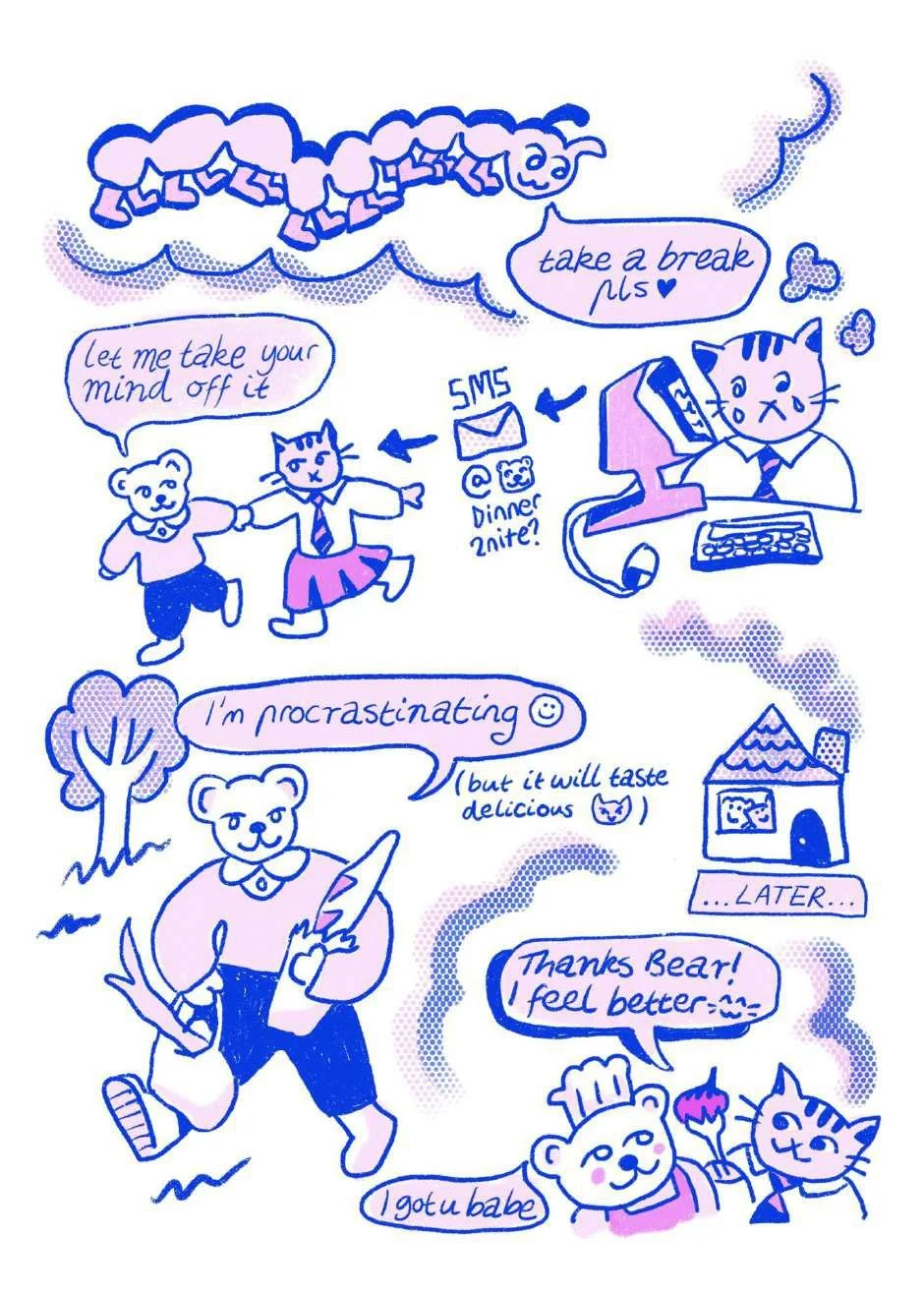
This piece and the illustration accompanying it here first appeared in the DISTRACTION exhibition zine.
Jasmin Pfefferkorn (author) is a Postdoctoral Research Fellow in the School of Culture and Communicationat The University of Melbourne. Her research sits at the intersections of critical AI, museum studies, aesthetics, visual culture, and computational cultures. She is the author of Museums as Assemblage (Routledge, 2023) and recently co-edited the volume Decentring Ethics: AI Art as Method (Open Humanities Press, 2025). She is the co-founder and director of the research group CODED AESTHETICS, and on the steering committee for the Art, AI and Digital Ethics collective at the Centre for Artificial Intelligence and Digital Ethics.
Zeth Cameron (illustrator) is an artist and occasional graphic designer. They love to facilitate creative workshops for young people and tinker about in their studio, where they are a Yarra Youth grant recipient and artist in residence. Their practice is grounded in their experiences with ADHD and gender non-conformity, and embraces work that is both playful and critical.